

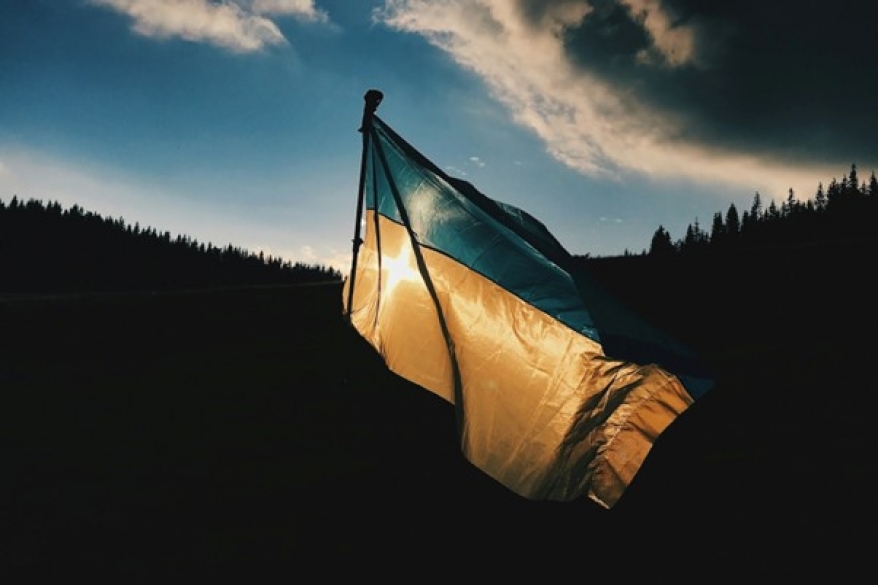
Welcome to Ukraine 2026. Life goes on: students continue to enrol in university, professors teach and conduct research, and the administration drowns in bureaucracy. Sounds familiar. It’s much like life in any other country of the world. Sirens continue to interrupt lectures, power cuts halt experiments, students and academics relocate or enlist. The next generation of Ukrainian scholars continues to teach, research, and rebuild—often simultaneously. If you are not already familiar with it, we recommend that you read and share the stories of Ukrainian early career researchers to get a sense of how the (grim) reality looks, and to understand how much capacity exists within the Ukrainian higher education and research community.
Yesterday marked four years since the beginning of this terrible, bloody, horrific, and senseless war, which has not only divided our lives into “before” and “after”, but has also thrown us backward in time and space. Four years is a long time. In most European countries, if you graduate on time, you would have completed your PhD within four years or less.
Rapid changes are taking place in the systems of education and science. The Ukrainian higher education and research sector has undergone significant transformation to align more closely with the EU, the European Research Area, and the European Higher Education Area. A key role for accelerating these changes has been played by international collaboration, networks, and mobilities, which do not both strengthen the quality of research and teaching, and build democratic resilience in important ways.
However, unlike in 2022, we cannot pretend in 2026 that this is a temporary emergency. It is the everyday reality of life in a country at war. In 2026, the question is not whether Ukrainian higher education needs support. The question is whether Europe is ready to match its declarations of solidarity with long-term action. And even if we may sound like a broken record, this is precisely why Europe’s solidarity must not fade. Ukraine, four years from now, will still need support and commitment from the European Union.
A pressing question, of course, is whether Europe remains committed to continuing this support. Yet another important question arises: what responsibility do we have as individual academics to contribute? What is our responsibility not only to advocate for continued support, but also to demonstrate solidarity ourselves?
Across the world, wars and conflicts persist, and as a consequence academic freedom and access to higher education are often in decline. The Council of Europe, the European Higher Education Area, and the European Union all, in different ways, link the mission of higher education and research to that of democracy. If this is not to remain merely rhetoric, it must be backed by action, including action by those of us who are part of the academic community.
And this begs the question: what can we do as individual academics, as early career researchers (or more senior, for that matter), as administrators or as leadership—both now and in the long term? In its essence, this is a question about the social responsibility we bear toward the world around us. A question that extends beyond Ukraine and beyond Europe’s borders
Thus, today our plea is that we all reflect on the responsibility we hold as individual academics and as members of a broader academic community. Our commitment to supporting our Ukrainians colleagues, as well as Palestinians, and all colleagues living and working under the threat of war or persecution, through inclusion in larger research collaborations, participation in capacity-building programmes such as Erasmus+ and Horizon Europe projects, and through training and education for the next generation of academics. This can be also in the form of initiatives such as training for doctoral candidates, joint doctoral supervision, mentorship programmes for early career researchers, as well as dedicated early-career funding opportunities such as the MSCA4UA initiative.
These four years have changed us all irrevocably. Perhaps this moment may also serve as a catalyst for greater transformation, and for reinforcing the democratic mission of higher education and for strengthening solidarity.
Signatories
- Anna Pavelieva
- Pil Maria Saugmann
- Nicola Dengo
- Aleksandra Lewandowska
- Norbert Bencze
- Manca Lunder
- Magali Weissgerber
- Linnéa Carlsson
- Luka Savic
- MJ Quill
- Margaux Introna